
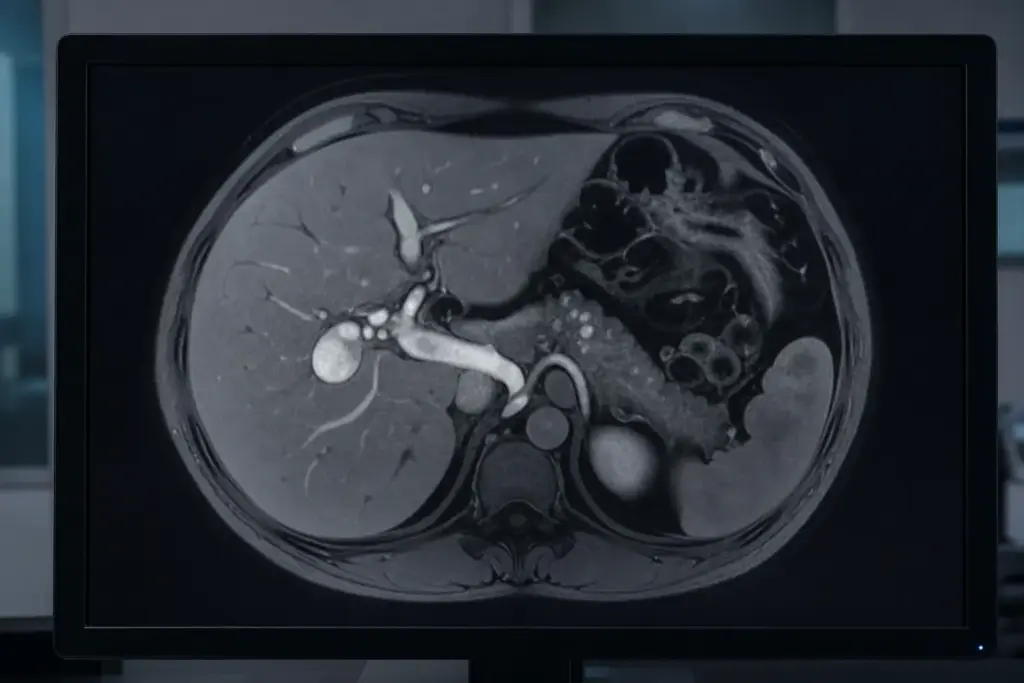
A stone stuck in the bile duct needs prompt attention, because a blocked duct can quickly lead to jaundice, infection or pancreatitis. Mr Naga Venkatesh Jayanthi provides bile duct stones treatment. Essex patients usually have the duct cleared first and the gallbladder removed afterwards.
What Are Bile Duct Stones?
Bile duct stones, also called choledocholithiasis, are gallstones that have passed from the gallbladder into the common bile duct, the tube that carries bile from the liver into the small intestine. Unlike gallstones that remain in the gallbladder, bile duct stones can block the flow of bile causing jaundice, serious infection (cholangitis), and inflammation of the pancreas (pancreatitis).
Patients are frequently referred directly to Mr Jayanthi from across Essex for bile duct stone management. He offers a dedicated one-stop keyhole service combining bile duct clearance and gallbladder removal in a single admission wherever possible.
What Are the Symptoms?
Bile duct stones may cause no symptoms at first. When the bile duct becomes blocked, symptoms typically include:
- Jaundice, with yellowing of the skin and whites of the eyes
- Dark urine and pale stools
- Severe upper abdominal pain
- Fever and rigors, signs of cholangitis, a medical emergency
- Nausea and vomiting
- Acute pancreatitis, inflammation caused by a stone blocking the pancreatic duct
- Itching (pruritus) caused by bile salts under the skin
Warning Signs: When to Get Urgent Help
Severe, sudden upper abdominal pain, pain that moves through to your back while you are vomiting, or a high temperature with shivering are all reasons to dial 999 or go to A&E. Yellowing of the skin or eyes needs help the same day too. Go to A&E if it comes with pain or fever; if it does not, speak to your GP urgently or call NHS 111. Yellowing can be harder to see on brown or black skin.
Diagnosis
Bile duct stones require specialist investigation. Mr Jayanthi will arrange the appropriate investigations including ultrasound scan, liver function blood tests, MRCP (specialist bile duct MRI), and endoscopic ultrasound. In many cases, an ERCP (endoscopic retrograde cholangiopancreatography) is arranged both to confirm the diagnosis and remove the stone at the same time.
Treatment
Treatment involves two stages. First, the bile duct stone is removed using ERCP, an endoscopic procedure performed through the mouth under sedation. During ERCP the opening of the duct is widened so the stones can pass through. Second, the gallbladder is removed by laparoscopic (keyhole) cholecystectomy to prevent recurrence, performed as a day-case procedure.
Mr Jayanthi’s one-stop service aims to complete both stages in a single admission, reducing waiting time and the risk of further complications. In selected cases, he performs laparoscopic common bile duct exploration (LCBDE), surgically clearing the bile duct at the time of gallbladder removal.